


FORWORK – Fostering Opportunities of Refugee WORKers
A pilot programme for early labour market integration of asylum seekers in Italy
2019-2021
The project
FORWORK is a labour market integration programme implemented in the Italian region of Piedmont between 2019 and 2021. The initiative offered a personalised bundle of services to asylum seekers hosted in reception centres, with the aim of fast-tracking their access to employment and supporting integration into Italian society. Rather than waiting for formal refugee status to be granted—a process that often takes several years - FORWORK engaged participants the early stages of their stay in Italy, helping them to navigate the local job market and establish the foundations for long-term autonomy.
A Collaborative, Evidence-Based Initiative
The programme was the result of a collaborative effort between public institutions and non-profit actors. It was developed jointly by ANPAL (the National Agency for Active Labour Market Policies), the Public Employment Service Agency of the Piedmont Region (APL), and the Fondazione Rodolfo Debenedetti, with the support of the Italian Ministry of Labour. The Prefecture of Turin also played a crucial role in enabling the initiative. Two local not-for-profit employment agencies, Exar Solutions and Inforcoop, were involved in the implementation.
FORWORK was funded by the European Commission under the Employment and Social Innovation (EaSI) 2014-2020 programme and was designed to incorporate international best practices in migrant integration. A key feature of the project was its commitment to rigorous evaluation, including a randomised counterfactual design to measure its effectiveness.
A Structural Gap in Reception Services
Italy’s reception system is structured around two main types of centres: SAI centres, which mainly serve recognised refugees and offer integration services, and CAS centres, where most asylum seekers are hosted during the initial—and often lengthy—phases of their application process. While SAI centres provide access to language training, job orientation, and social services, CAS centres focus primarily on emergency accommodation and basic needs, offering little or no support for labour market integration.
Over time, the CAS network has become the backbone of Italy’s reception system, hosting more than three-quarters of asylum seekers nationwide. Yet it remains under-resourced and poorly equipped to support meaningful integration.
FORWORK was designed to address this significant gap in reception policy. By targeting asylum seekers in CAS centres, the programme introduced tailored, one-on-one employment support at a stage when such services are virtually absent. In doing so, it offered a rare opportunity to test early, structured interventions in an otherwise unstructured environment—helping individuals prepare for work and connect with local communities in the early months following their arrival in Italy.
Why Piedmont?
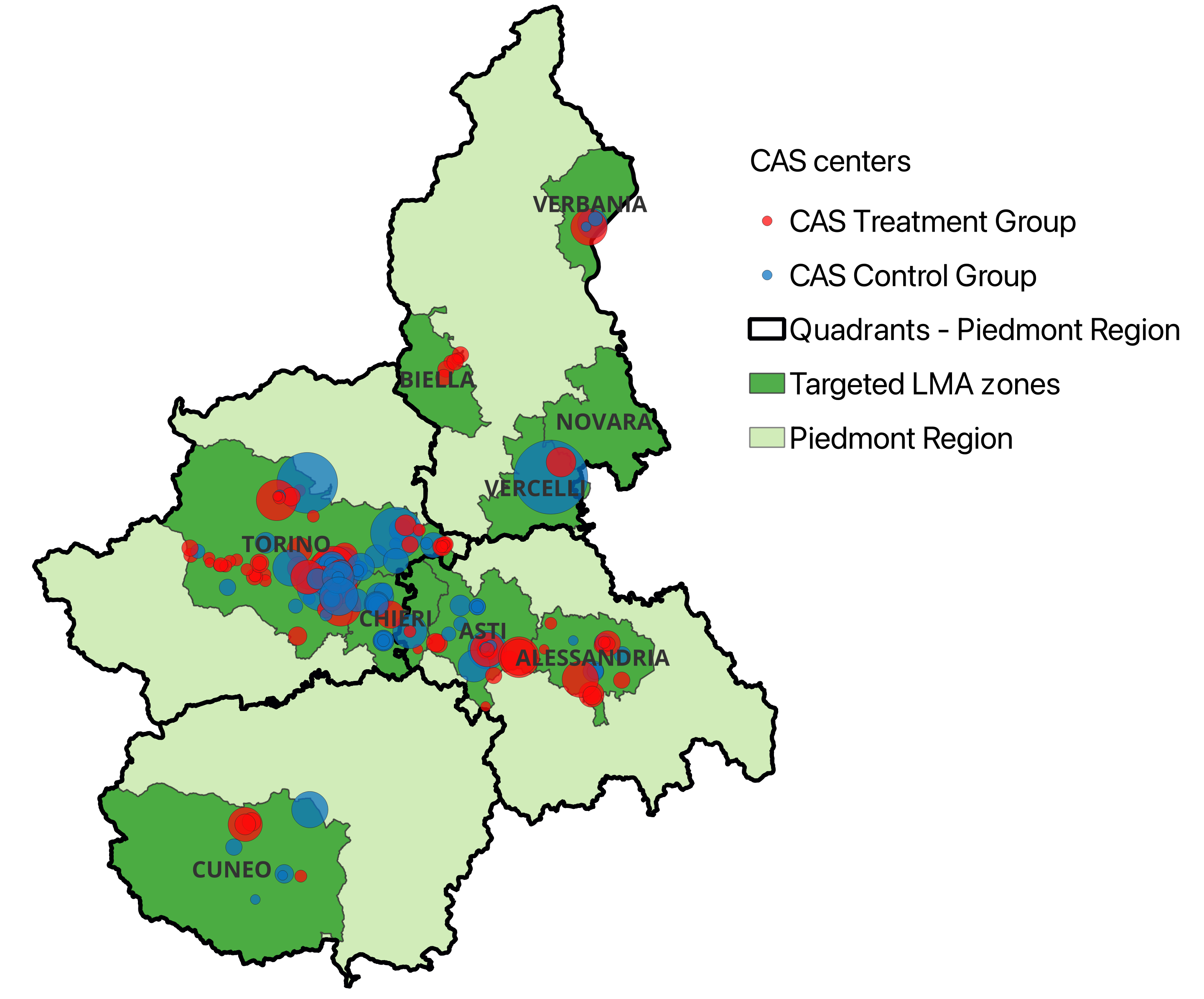
Piedmont is a large region in northwestern Italy with a population of 4.3 million. As of early 2019, it hosted over 11,000 asylum seekers, the vast majority of whom were accommodated in CAS (Centri di Accoglienza Straordinaria) reception centres. These centres are managed by local institutions (often NGOs and cooperatives) and are not required to provide integration services beyond food and shelter.
The programme focused on CAS centres located in urban areas of the region, specifically across eight Local Labour Market Areas (LMAs), including the city of Turin and six provincial capitals. Reception centres were selected based on their accessibility by public transport and proximity to public employment services, ensuring that participants could take part in programme activities with minimal logistical barriers. Furthermore, only CAS centres hosting fewer than 30 individuals were included, reflecting the small scale of most reception facilities in Piedmont.
Programme Design and Activities
The core idea behind FORWORK was to offer early, tailored support to asylum seekers during the period when they are legally permitted to work (60 days after filing their application for international protection), but typically receive very limited assistance. The programme combined personalised mentoring, placement support, and on-the-job training (though subsidized internships), while also offering language and civic education as needed.
Upon entering the programme, participants met with a job mentor who guided them through an assessment of their skills and prior work experience, using the EU Skills Profile Tool for Third Country Nationals. Together, they developed an individualised integration plan, adapted to the participant’s aspirations and employability profile.
Additional (optional) support included:
- Job placement services, provided by job coaches, who offered career guidance and liaised with potential employers
- Subsidised internships, funded by the Ministry of Labour and lasting 3–5 months, which provided participants with initial work experience and a pathway into regular employment
- Language and civic training, offered in group sessions and tailored to occupational needs
During the COVID-19 pandemic, many of these activities were delivered online, and the emphasis shifted further toward individualized labor market support services such as mentoring and placement.
Participation and Take-Up
Of the 622 asylum seekers assigned to the treatment group, 66% chose to participate in the programme, resulting in 409 individuals actively involved in FORWORK activities. All participants received personalised mentoring, while 58% accessed job placement services, and 20% took part in subsidised internships. A smaller share, around 25%, also attended language, civic, or vocational training courses.
Despite the challenges posed by the COVID-19 pandemic, participation remained high, supported by the programme’s ability to adapt its services for remote delivery when needed.
Evaluation Design and Methodology
A central objective of FORWORK was to provide credible evidence on the effectiveness of active labour market policies for asylum seekers. To this end, the programme was accompanied by a counterfactual evaluation. Eligibility was randomly assigned across 260 CAS centres in Piedmont, generating two groups: one eligible for the programme and one control group without access.
The evaluation combined administrative data from the Piedmont employment registry (SILP – Sistema Informativo Piemonte Lavoro) with two rounds of survey data, collected before and after programme implementation. This approach made it possible to track not only employment trajectories, but also informal work, language proficiency, social networks, and levels of trust—dimensions that are often omitted from administrative sources alone.
Key Results
The evaluation showed significant gains in employment, job quality, language proficiency, and social integration.
Employment
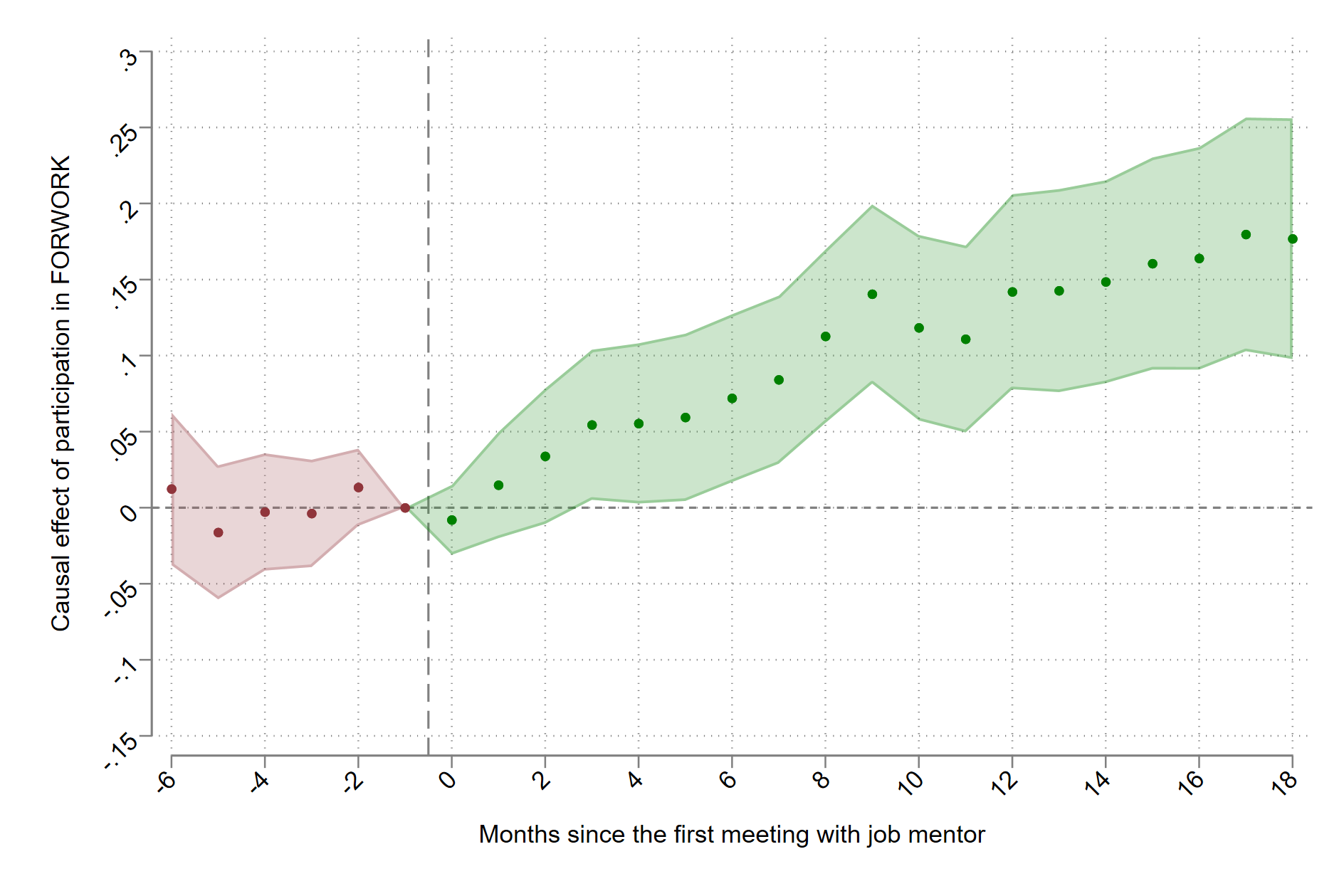
- After 18 months, employment rates increased by 10 percentage points, from a baseline of 33% to 43% (a 30% relative gain over the baseline).
- The impact was particularly pronounced among women, with an 8–10 percentage point increase in employment rates (from a baseline of 12–15%)—representing a 67% relative gain.
- Among men, the increase was 15 percentage points, over a baseline of 38% (a 39% relative gain).
Importantly, these employment effects were not driven by a shift from informal to formal work. Survey data confirmed that the observed increases corresponded to net job creation, not reclassification.
Job Quality and Internships
- The program improved job quality through increased access to fixed-term and open-ended contracts. It also raised labour earnings (by 30% after 18 months).
- Subsidised internships, offered to one-fifth of participants, played a key role in transitioning participants into standard employment.
Language skills and Social Integration
- Participation improved language skills, increasing understanding, speaking, reading, and writing proficiency in Italian by 15-20 percentage points.
- We also observe greater social interactions with Italians, with participants more likely to meet with Italians outside of reception centres. Trust in Italians also increased.
Program cost and Sustainability
FORWORK proved to be both effective and cost-efficient. The total cost was approximately €3,171 per participant, or €2,080 per eligible individual, placing it well within the range of recent Italian active labour market programmes. The vast majority of funds—around 80%—were directed to service delivery and personnel, with the remaining funds covered coordination (14%) and subsidised internships (6%).
This cost structure is comparable to other recent ALMPs initiatives for unemployed people in Italy, like the Assegno di Ricollocazione or the Garanzia di Occupabilità dei Lavoratori (GOL), which similarly provide personalised employment support.
Publications
- FORWORK Italy- Impact evaluation report
The FORWORK evaluation report, submitted to the European Commission in November 2021, assesses the impact of a labor market integration program for asylum seekers in Northern Italy, shortly after the program's conclusion.
- FORWORK Italy - Description of activities with asylum seekers
Qualitative overview of the activities provided to asylum seekers in Italy under the FORWORK program
- Working paper “Fast-Tracked Jobs Help Asylum Seekers Integrate Faster” (2025) by Giovanni Abbiati, Erich Battistin, Paola Monti and Paolo Pinotti.
Contenuti correlati
Allegati
